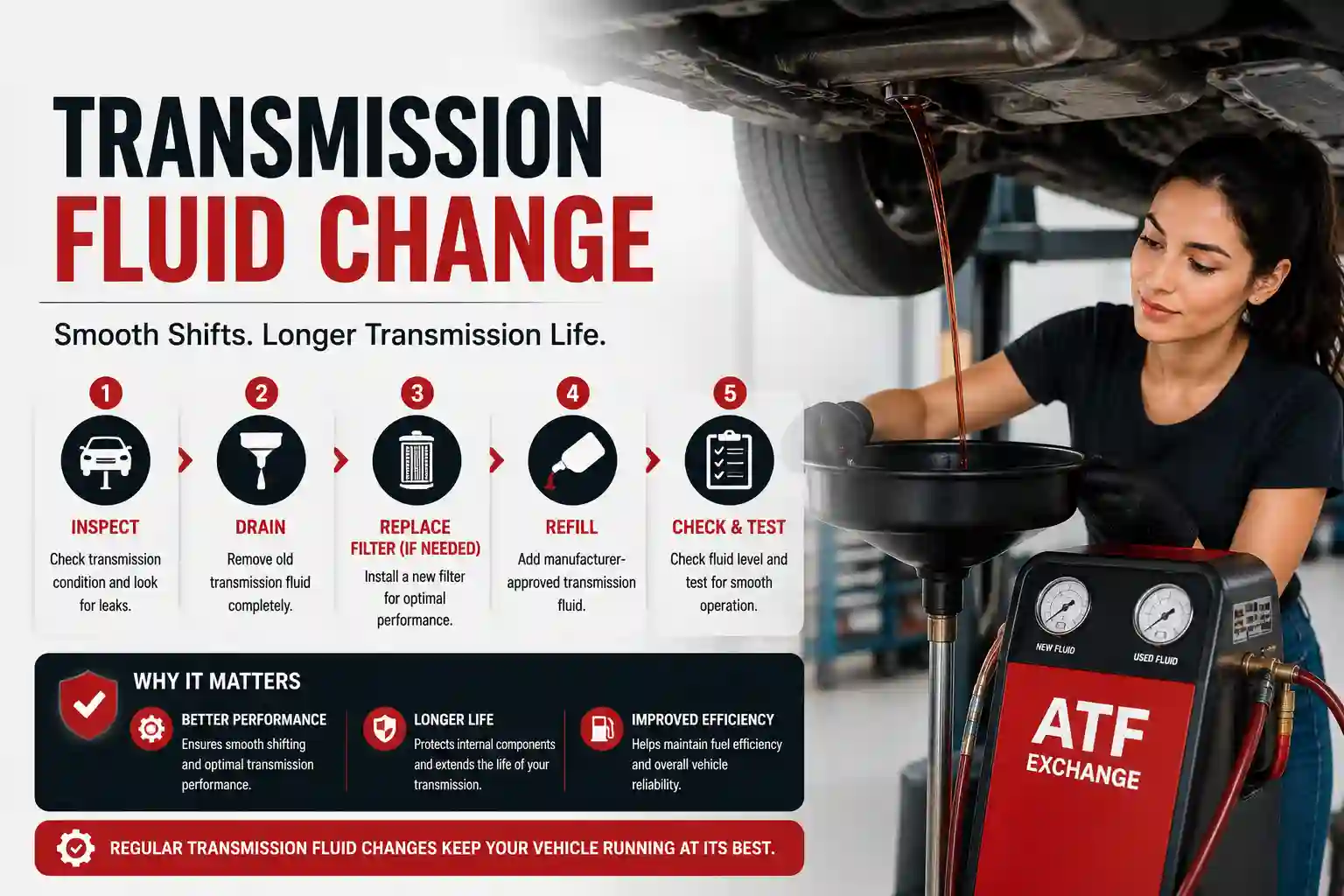

I once watched a friend’s transmission start “thinking twice” before responding that’s genuinely the best way to describe hesitant gear engagement once you’ve felt it a few times. He asked me the question everyone asks: do you think I need a new transmission? The real answer, almost every time someone asks that, is simpler and cheaper than they expect: nobody had performed a transmission fluid change in longer than anyone could remember.
Transmission fluid is much more than a crude oil product. It’s the fluid lifeline drivetrain and fluid lifeblood transmission system depend on lubricating gears, transferring hydraulic pressure to the torque converter and valve body, and carrying away heat that would otherwise cook the internal components. A transmission fluid change is the best insurance policy against a $4,000 rebuild, and once you understand the actual process, it’s a service most drivers can either do themselves or supervise intelligently when paying someone else to do it.
Why Transmission Fluid Change Timing Depends on Your Transmission Type — Not Just Mileage
The single biggest mistake people make is treating every transmission the same way. Manual transmission every 30000 to 60000 miles is the standard interval. Automatic transmission 60000 to 100000 miles is the typical window Toyota ATF 60K to 100K miles confirms this is consistent across major manufacturers, with Toyota CVT 30K to 60K miles showing CVT 30000 to 60000 miles needs servicing roughly twice as often as a conventional automatic. DCT dual-clutch interval falls somewhere in between depending on manufacturer.
Severe conditions 25000 to 60000 miles applies if you’re towing shorten interval, driving in hot climates shorten interval, or dealing with stop-and-go shorten interval city traffic daily. Severe duty halve interval is the practical rule of thumb if you’re not sure whether your driving counts as severe, assume it does and service more often. Manufacturer schedules conservative is worth remembering too: the factory-recommended numbers assume ideal conditions that most actual driving doesn’t match.
Lifetime fill transmission still benefits service is a phrase worth internalising “lifetime fill” doesn’t mean “never touch it.” Fluid inspection every 3 to 4 years low mileage applies if you’re driving fewer than 10000 miles per year threshold; mileage-driven not time-based Toyota guidance is the manufacturer’s official stance, but time matters too because fluid degrades chemically even sitting idle.
ASE certified recommend 30000 to 40000 miles CVT regardless of what the owner’s manual says ATRA certified transmission specialist shops with ATRA ASE certified technicians who’ve performed ATRA ASE since 1997 levels of experience tend to recommend tighter CVT intervals than manufacturers publish, because they’re the ones who see what happens when CVT fluid gets pushed too far past its service life.
Reading the Fluid Before You Decide Anything — What Colour and Smell Actually Tell You
Before committing to a flush, a drain-and-fill, or doing nothing at all, check fluid colour clear reddish. Pull dipstick warm check fluid colour while the engine is at operating temperature on vehicles equipped with a transmission dipstick. Wipe fluid white paper towel to get an accurate read away from engine bay shadows.
Bright red or pink healthy fluid means everything’s in good shape reddish translucent fluid with no unusual smell is the baseline. Light brown normal aging is expected as miles accumulate and shouldn’t trigger panic. Dark brown or black burnt smell, however, means the fluid needed changing thousands of miles ago burnt toast smell specifically points to overheated fluid friction material, which tells you the transmission has been running too hot, likely due to low fluid old degraded fluid or mechanical problems excessive friction somewhere in the system.
Signs transmission fluid needs changing extend beyond the dipstick. Slipping gears, poor acceleration, rough gear shifts, and old or dirty transmission fluid visible through a check are all valid triggers. Watch dashboard alerts too: transmission warning light or check engine light transmission can indicate shift solenoids fault, speed sensors fault, or other electronic components fault these often appear before complete transmission failure becomes a reality, so don’t dismiss them as unrelated to fluid condition.
Here’s the critical distinction, though: hesitant gear engagement, delayed engagement, and harsh shifts that have progressed to symptoms internal wear are not solved by adding fresh fluid. The fresh oil engine thrown rod analogy applies directly fluid change will not fix failing transmission damage that’s already occurred mechanically. If you’re seeing strange shifting odd noises alongside slipping gears burning smell, that’s emergency immediate diagnosis territory. Do not drive vehicle until inspected. Do not add fluid on top of old fluid hoping it dilutes the problem away full drain-and-fill or professional diagnostic required is the correct path, and it requires diagnosis possible rebuild conversation with someone qualified before you spend money on fluid that won’t address the underlying issue.
Flush vs Drain-and-Fill — Choosing the Right Service for Your Transmission’s History
Transmission flush vs fluid change confusion costs people money in both directions paying for more service than needed, or choosing a cheaper option that doesn’t actually solve the problem. Drain and fill removes 30 to 40 percent of the old fluid by gravity through the drain plug or pan some sources put this slightly higher, citing common for a simple drain and fill procedure to only replace about 40 to 60 percent of the total volume depending on transmission design. Full flush replaces 90 to 100 percent because flush uses machine push fluid through system, forcing new ATF through every line, the torque converter, and the cooler circuit rather than relying on gravity alone.
Drain and fill safer high mileage is the consensus among specialists, because flush risk dislodging debris and flush risk clog valve body are real concerns in a transmission that’s accumulated years of sediment. For high mileage unknown history vehicles, the gradual approach two cycles method works well: drive 500 to 1000 miles between cycles, doing a drain-and-fill, driving the interval, then repeating. This is sometimes called the poor man’s transmission flush three pan drops remove most old fluid without the hydraulic shock of a machine flush all at once. If you want a more aggressive single-session method and your fluid history is unknown, dislodging accumulated deposits clog passages is the genuine risk you’re weighing against thoroughness.
For moderately aged fluid flush restores quality more completely if your fluid is dark brown but the transmission is otherwise shifting normally, a flush is reasonable. CVT follow manufacturer guidance flush is important because CVT systems vary significantly by manufacturer in how they handle a full flush procedure.
The Manual Transmission Process — Why It’s the Easiest DIY on This List
Manual transmission fluid change is genuinely manual gearbox DIY-friendly, and manual transmission easiest DIY is accurate: there’s no torque converter, no valve body, no electronic components to worry about just gear oil moving through a simple housing. Manual no slipping symptoms until very degraded is also worth knowing, since the lack of early warning means a scheduled interval matters more here than reacting to symptoms.
Locate drain and fill plugs on the transmission housing drain plug lowest point housing, fill plug side or top of case. Consult service manual exact locations since these vary significantly by make and model; mark plug positions photo before you go underneath if you’re unfamiliar with the layout. Drain gear oil from drain plug into your catch container, and while it’s draining, inspect drain plug magnet metallic debris a magnetic drain plug collecting fine metal particles is normal; chunky debris is not.
Refill through fill plug using a long thin funnel or flexible hose funnel, filling until seeping out correct level that seep is your signal to stop, not a mess to avoid. Viscosity grade varies by transmission design, so confirm the exact gear oil spec before buying anything.
The Automatic and CVT Process — Where the Real Technique Lives
For an automatic, gather your tools first: hydraulic jack, jack stands, ramps, socket set, torque wrench, drain pan, shop rags, nitrile gloves, safety glasses, funnel, and wheel chocks. Run engine warm up — drive 5 to 10 minutes warm fluid or drive 10 to 15 minutes operating temperature, because warm fluid drains more completely and warm fluid holds contaminants suspension that cold fluid does not drain completely. Turn off engine after warm up, park on flat level surface, engage parking brake, and place wheel chocks before raising the vehicle.
Raise vehicle safely, secure on jack stands never work under car supported only by jack. Give vehicle firm shake verify stability before going underneath; double-check stability isn’t optional.
Position drain pan beneath transmission and here’s a detail most guides skip: position drain pan slightly forward, because fluid shoots farther than expected once the last bolts come loose. If your transmission has a drain plug, remove drain plug carefully (fluid will be hot) and let it drain fully.
If not, loosen pan bolts gradually in a cross pattern, leaving two bolts finger-tight on opposite corners, then gentle pull pan apart create gap to begin the drain this ATF shower prevention technique keeps fluid flowing into your pan rather than across the garage floor. Remove remaining bolts, lower transmission pan, clean pan interior brake cleaner, and remove sludge from pan thoroughly. Replace transmission filter and replace gasket if applicable install new filter and gasket as standard practice, then reattach pan and torque pan bolts to spec using your torque wrench, since these are low-range foot-pound values or inch-pound values specifically chosen to prevent leaks soft aluminum damage.
Add fluid through fill hole using a funnel, filling to the manufacturer-specified amount. Start engine, keep your foot on the brake, and shift through every gear P-R-N-D-L, holding each gear three seconds this circulates fluid torque converter valve body throughout the system. Check level engine running idling park is the rule for most automatics: never check fluid level engine off, because the dipstick reading is only accurate at operating temperature with the engine running. Add fluid in small increments if it reads low, recheck after each addition.
CVT fluid change carries genuinely different rules. CVT fluid temperature calibration and CVT computer reset requirement mean CVT not DIY-friendly for most owners CVT fluid change complexity comes from CVT specific procedures most home garages aren’t equipped for. CVT wrong fluid serious damage and CVT overfilling damage are both real risks since CVT fluid specially made chemistry doesn’t tolerate substitution.
A CVT weep hole indicator correct level fluid seeping from a designated weep hole is how many CVTs confirm proper fill level rather than a dipstick. CVT drain and fill only third of fluid per session is typical, so CVT three drain and fills mostly new fluid, using roughly CVT 12 quarts three drain fills total, gets you close to a full fluid replacement without machine equipment.
Whatever method you use, finish with a test drive after fluid change, listening for grinding noises test drive that would indicate a problem introduced during the service. Record date mileage fluid change in your maintenance log so the next interval decision is based on fact, not guesswork.