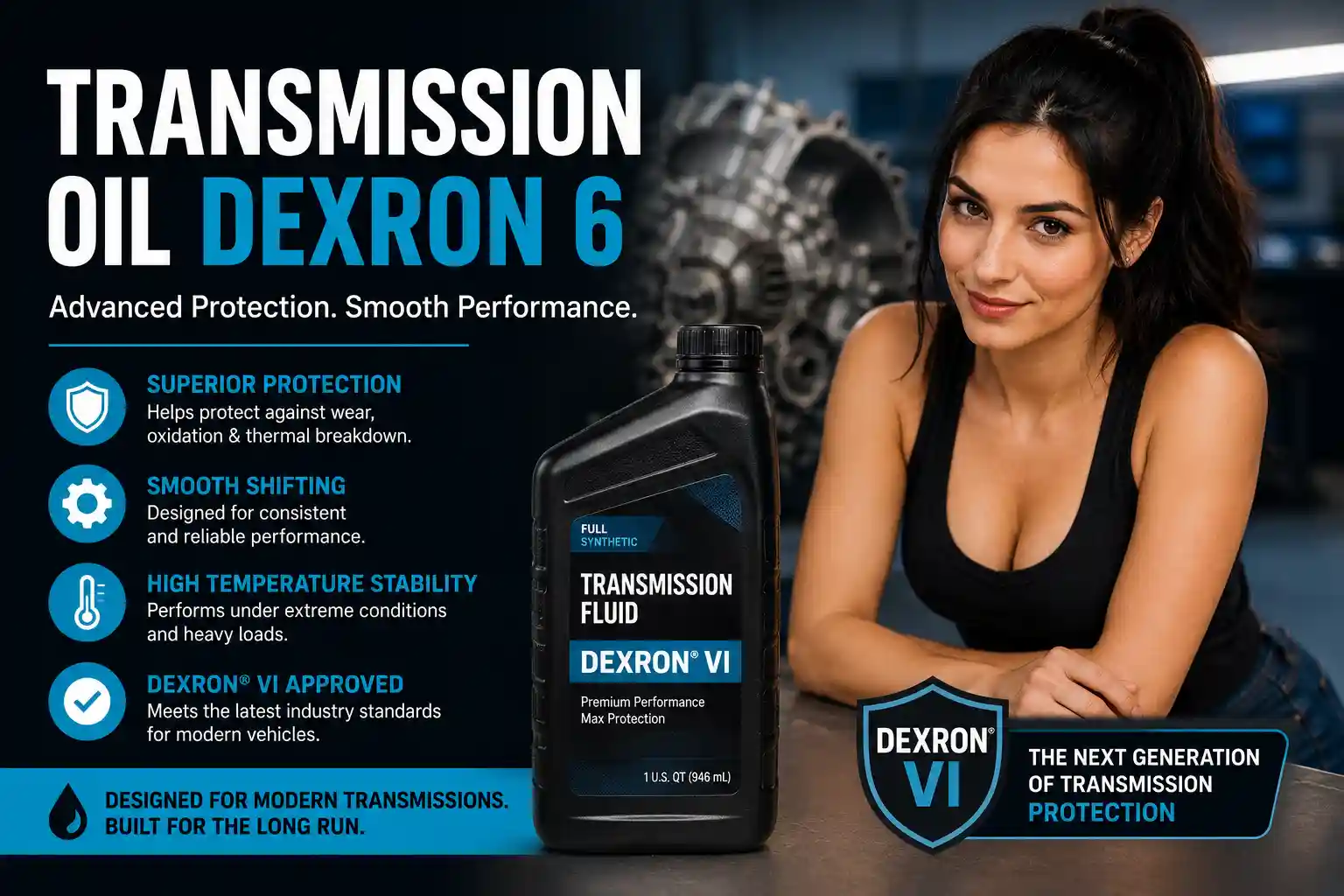

I had a customer come in years ago holding two bottles of transmission fluid one labelled Dexron III, one labelled Transmission oil Dexron 6 convinced he was about to make an expensive mistake either way. He’d read forum threads, half of which said throw Royal Purple Synthetic ATF and be done, the other half insisting GM stopped selling Dexron III at dealer locations entirely. Both were sort of right. That confusion is exactly why this topic deserves a proper explanation rather than another forum thread full of opinions.
Transmission oil Dexron 6 ATF isn’t a marketing refresh of Dexron III. It’s a genuinely different specification, built around different chemistry, written for transmissions that didn’t exist when Dexron III was current. Understanding what changed and why answers almost every question people ask about whether dexron VI is the same as dexron 3, whether it’s backward compatible, and whether you’re overpaying for something your car doesn’t need.
The History Behind Dexron — From 1937 Hydra-Matic Fluid to Transmission oil Dexron 6
DEXRON history goes back further than most drivers realise. The Dexron timeline starts in 1937 Gargoyle Mobiloil, used in GM’s Automatic Safety Transmission an extra-cost option Oldsmobile offered for their Six and Eight models during the 1938 and 1939 model years only. By 1940, Hydra-Matic fluid covered GM’s first mass-produced automatic transmission.
As transmission designs evolved through the 1950s 1956 Buick Dynaflow, 1957 Chevrolet Turboglide, 1957 Buick Flightpitch Dynaflow GM released Type A Suffix A fluid 1957, a specification better suited to the higher fluid temperatures these new torque converters generated. The fluid specification revised 1958 1959 1960 repeatedly through GM’s licensing program, which allowed oil companies to produce fluid under their own brand name carrying the armor qualification license AQ-ATF designation.
That lineage continued through Dexron, Dexron II, Dexron IIE, and Dexron III with Dexron III H representing a hardened variant under the TES-389 specification. Then came the real shift: Dexron VI introduced April 2005 as the next-generation factory fill fluid, specifically for transmission oil Dexron 6 2005 model year and transmission oil Dexron 6 for 2006 model year vehicles.
The driving reason was the GM 6L80 transmission a 6-speed automatic transmission, Hydra-Matic 6L80, that placed direct contact between clutches under conditions Dexron III was never designed for. Increased torque ratings, reduced sump volumes, and higher fluid turnover rates all demanded a fluid with better shear stability and thermal stability than anything before it. Dexron III H licenses expire end of 2006 after that point, GM owner’s manuals stopped recommending anything but Dexron VI.
It doesn’t stop there. As GM moved into 6 8 9 10-speed transmissions, and as plug-in hybrid PHEV transmission fluid and electric vehicle EV transmission technology entered the lineup, specialized fluids modern transmissions became necessary again. The DEX-CVT specification exists separately precisely because transmission oil Dexron 6 was never designed for continuously variable transmissions CVT separate fluid specification is a distinct chemistry entirely, and using transmission oil Dexron 6 in a CVT is a mistake regardless of how compatible it seems on paper.
What Makes Dexron VI Different From Dexron III — The Chemistry Explained
The headline technical difference is viscosity. Transmission oil Dexron 6 spec calls for 6.4 cSt at 100°C, compared to 7.5 cSt Dexron III. That’s not a small adjustment transmission oil Dexron 6 thinner ATF gas mileage benefits come directly from this reduction, since a thinner fluid circulates with less pumping resistance and contributes to fuel economy. GM then specified a 5.5 cSt viscosity loss limit for in-service degradation interestingly, that’s the same ceiling Dexron III used, meaning transmission oil Dexron 6 has to maintain a tighter starting point while degrading no faster than its predecessor.
Achieving that requires more than a thinner base oil. The full additive package and base stock combination has to deliver shear resistance and oxidation resistance simultaneously properties that synthetic-based fluid formulations handle more reliably than older mineral-based chemistry. Dexron VI carries excellent thermal stability, low pour point, and high viscosity index as headline beneficial qualities. In practical terms: keeps moving parts clean for smooth gear shifting and low shudder, maintains viscosity at both high and low temperatures, exhibits outstanding wear reduction properties, resists oxidation and contamination ensuring extended drain intervals, and prevents metal corrosion through corrosion inhibitor chemistry.
There’s also a less-discussed angle: seal swell agents and seal compatibility. GM’s specification includes formal testing Standard Reference Elastomers SRE pieces are suspended in 300 ml formulation test conditions at 150°C elastomer test temperatures for 504 hours elastomer test duration, with volume change and Durometer readings recorded under ASTM D4289 methodology before and after. This is how GM verifies that Dexron VI won’t cause elastomeric seal materials to swell or shrink in ways that create leaks a detail that matters enormously for transmission longevity but rarely gets discussed outside specification documents.
Is Dexron VI Backward Compatible With Dexron III? — The Compatibility Question Answered
Backward compatible dexron VI is the short answer, and it’s confirmed repeatedly across GM’s own documentation and third-party fluid manufacturers. Dexron VI backward compatible dexron III, dexron VI replaces dexron III, dexron VI replaces dexron II completely downward compatible is the phrase RAVENOL uses, and it’s accurate. If your owner’s manual specifies Dexron, Dexron II, or Dexron III, Dexron VI is recommended for previous dexron fluids and will work correctly.
This applies across a wide range of specific transmission models: dexron VI 4T65E, dexron VI 4T45E, dexron VI 4L65E, dexron VI 4L80E, and 4T80E transmission fluid applications all accept Dexron VI without issue. The T56 transmission fluid question comes up often too the T56 service manual dexron II baseline means Dexron VI is an acceptable upgrade there as well, though T56 is a manual gearbox and Mercon H requirements apply in some configurations.
Where it gets more nuanced is mixing. Mixing dexron VI with dexron III for a top-up is generally considered low-risk mixing dexron fluids of overlapping specifications doesn’t typically cause the kind of damage that mixing fundamentally different chemistries does. But for a full service, a complete fluid change vs partial drain and refill method matters more than whether trace amounts of the old fluid remain.
Cross-brand compatibility extends further than GM alone. Dexron VI mercon LV compatible products exist mercon LV dexron VI dual approval is common in synthetic blends like CITGO TransGard, which explicitly states it’s not backward compatible mercon versions except for mercon SP 5R110W application, a specific Ford transmission. BMW dexron VI approval covers specific part numbers BMW 83220397114 and BMW 83222167720 alongside GM1940184 and GM93165414 reference numbers. Mercedes approval dexron under MB approval 236.41 confirms dexron VI approved hydramatic transmissions extends to Mercedes-Benz applications using Hydra-Matic-derived units, with Mercedes 5.8 quarts torque converter capacity being a commonly cited figure for full service volume.
Should You Use Dexron VI in a Pre-2006 Vehicle? — And What About Toyota, BMW, Mercedes?
Dexron VI in older transmission applications is not just acceptable for vehicles built before dexron VI from 2006, it’s often the recommended upgrade path since dexron III hard to find and dexron III phased out at most retailers. If your Cadillac Fleetwood Brougham 80-96, Chevy TrailBlazer dexron application, or GMC Envoy dexron specification originally called for Dexron III, Dexron VI works fine and typically performs better.
Toyota dexron compatibility is where things diverge. Toyota Type T-IV transmission fluid T-IV AT fluid is Toyota’s own specification, and the advice is consistently do not use dexron III in automatic transmission applications calling for T-IV. However, MaxLife dexron VI compatibility list products are formulated as Dexron VI with many different additives specifically to give that giant compatibility list spanning Ford, GM, Toyota, and BMW. MaxLife works in Ford GM Toyota BMW applications because the additive package is engineered to satisfy multiple OEM requirements simultaneously Pontiac Torrent T-IV vs dexron VI replacement is a frequently asked version of this same question, and MaxLife-style fluids resolve it.
The broader principle universal ATF compatibility raises is worth internalising: universal ATF risk exists when a product claims compatibility without independent verification. Look to spec not brand, industry-wide specifications is the correct framework automotive engineers choose fluids by specification number, not brand reputation. Amsoil Signature Series spec sheets, for example, document exactly which specifications their products meet rather than relying on brand trust alone.
Choosing a Dexron VI Brand — Full Synthetic, Blend, and Price Differences That Matter
Full synthetic dexron VI brands list includes Mag 1, Valvoline (claiming full synthetic), Amalie/Wolf’s Head, Redline D6, and Peak. Semi-synthetic dexron VI brands list and blend dexron VI brands include Castrol, Pennzoil, Mobil, Supertech, and ACDelco’s OE factory fill most store brand dexron VI products fall into this blend category as well.
GM Dexron VI is itself semi-synthetic in factory fill form, despite GM specifying synthetic-based fluid as a beneficial quality category broadly. Mobil 1 not rated dexron VI is a detail that surprises people Mobil 1 ATF viscosity issue is the reason: Mobil 1’s formulation doesn’t meet the 6.4 cSt at 100°C threshold, so despite being a premium synthetic product, it isn’t licensed under the Dexron VI specification.
On price: $5 per quart full synthetic is achievable Mag1 full synthetic best deal pricing has been reported around $3.99 per quart Amazon free shipping deal territory, while $5.49 per quart Valvoline full syn is typical retail. Dealer pricing runs higher $8.50 per quart dealer price reflects GM-branded product margins.
By comparison, under $3 per quart Dexron III remains available as Super Tech dexron VI alternatives or older-spec products at Walmart dexron VI price points. The 3 to 4 times cost dexron VI vs III gap is real for anyone doing a full flush at 13 quarts pumped out for a typical service, that difference becomes a meaningful budget line, prompting the $200 ATF cost concern that shows up in forum discussions regularly.
AMSOIL low viscosity universal ATF AMSOIL ATL product code sits in an interesting position: AMSOIL not GM licensed but tested means it meets the performance specification without carrying GM’s formal license, which some consider AMSOIL ATL not GM licensed but tested superior due to its formulation exceeding minimum requirements. AMSOIL dealer wholesale 25 percent below retail through the AMSOIL Preferred Customer Program is a genuine cost-saving route for anyone using AMSOIL Torque-Drive or AMSOIL Signature Series products regularly.
A Word of Caution on High-Mileage Transmissions
New fluid high mileage caution deserves real attention. Fresh fluid damages clutch plates high mileage is a documented anecdote pattern flushing high mileage transmission risk exists because clutch material that has adapted to degraded fluid chemistry over 220000 miles MaxLife transmission still shifting excellent territory can react poorly to a sudden full flush.
If your transmission has gone 30000 miles, 60000 miles, even 100000 miles or 200000 miles interval without a change and is shifting fine, a full flush carries real risk of revealing problems that a partial drain-and-fill wouldn’t trigger. Suctioning power steering reservoir three or four times year is a separate but related technique some use for gradual fluid replacement in PS systems where ATF compatible with PS reservoir applies power steering fluid compatibility with ATF is common in older GM and Toyota systems specifically.
Always check owners manual before switching fluid types, particularly if vehicle still under warranty fluid requirement applies fluid must meet GM specs warranty, and voiding warranty wrong fluid is a real consequence of using an unlisted product on a vehicle still covered.
2 thoughts on “Transmission Oil Dexron 6 — What It Actually Is, and Why Your Owner’s Manual Suddenly Stopped Saying Dexron III”