
There’s a specific kind of dread that comes with the oil warning light coming on while you’re doing 70 on a motorway. I know because it happened to a friend of mine driving a Ford Fiesta between Manchester and Glasgow. By the time the oil pressure light lit up, the engine was already working harder than it should have been. A simple check before that long journey two minutes, a clean rag, nothing more would have caught it. That repair bill ran close to £5000. The check costs nothing.
Knowing how to check oil in car isn’t mechanical knowledge; it’s basic ownership responsibility. Whether you drive a new BMW with a digital instrument cluster, a Toyota Yaris on a tight service budget, or a Ford F150 with 80,000 miles on it, the principle doesn’t change: oil is the engine lifeblood, and keeping tabs on it is the single most cost-effective piece of car maintenance you will ever do.
Why Engine Oil Does Far More Than Lubricate
Most drivers think engine oil is there to stop metal grinding on metal. That’s part of it, but it undersells what the fluid is actually managing inside a running engine. Motor oil lubricates moving parts, yes but it also handles heat dissipation, suspends dirt and combustion byproducts in suspension so they can’t settle, guards against rust on internal engine components, and protects engine surfaces from corrosion prevention degradation between changes.
When engine health starts to slip from insufficient oil, it rarely announces itself dramatically at first. More often it’s a subtle engine noise, a faint engine ticking at cold start, slightly reduced performance, or a marginal drop in fuel efficiency you might dismiss as seasonal variation. By the time engine knocking and grinding sounds appear, the damage to moving parts is already underway. Engine sludge and engine deposits begin forming when oil breaks down without being refreshed, and the downstream consequences locked-up cams, frozen pistons, catastrophic engine failure are the kind of outcomes that turn a £132 oil change into a full engine rebuild.
Operating temperature for most engines sits between 230 to 260°F in normal use. At those temperatures, oil is working extremely hard. Oil degradation, oil oxidation, and chemical makeup changes happen progressively with every heat cycle. An engine that never gets its oil checked between changes is an engine running on increasingly compromised protection and no oil change indicator light on the dashboard changes that reality.
What You Need Before You Pop the Hood
Checking oil in car requires no special tools and no technical background. A clean rag or paper towel, a lint-free cloth for wiping, and about 10 minutes are the entire requirement. Safety glasses are worth wearing if you’re not used to working under the bonnet it’s a sensible habit when your head is near any engine bay component. Work gloves optional, but useful for keeping your hands clean.
Before you touch anything, consult owner’s manual or vehicle handbook for two things: where the oil dipstick is located on your specific engine layout, and whether your manufacturer recommends a cold engine preferred check or warm engine acceptable check. Some modern vehicles Ford models after 2016 with IOLM systems, certain Audi and Mercedes-Benz configurations have recalibrated their dipstick markings to be accurate at operating temperature, meaning a cold engine reading on those vehicles may not be reliable. Your owner’s handbook resolves this in thirty seconds.
Also worth checking: does your car even have a traditional dipstick? Cars without dipstick are increasingly common. Mercedes-Benz no dipstick configurations, BMW no dipstick setups, RAM 1500 no dipstick arrangements via Stellantis, and various luxury car oil check methods all route through digital oil level readout instead. For those vehicles, navigate dashboard menu or infotainment system to the oil monitoring section with the engine warm. Electronic oil monitor systems use an oil level sensor and oil temperature sensor to feed real-time oil monitoring data to the onboard computer. The principle of checking regularly still applies electronic system fail-safe features exist, but sensor failure risk is real, warning light fails without notice, and no digital readout replaces the habit of manual verification still important on any vehicle.
The Correct Way to Check Oil in Car — Step by Step
For every vehicle that does use a traditional dipstick, here is what a correct oil level check car actually looks like.
Park on level ground level plane, flat surface, not on a driveway camber or kerb lean. Engage parking brake. Turn off engine and wait. The standard recommendation is wait 10 to 15 minutes after driving, though some manufacturers say wait 20 minutes or even wait 30 minutes for complete oil drain back. The oil needs to settle back into the oil sump and oil pan before the reading is meaningful. Checking immediately after a drive gives you a false reading because oil is still circulating through the valve cover, engine block, and upper engine areas.
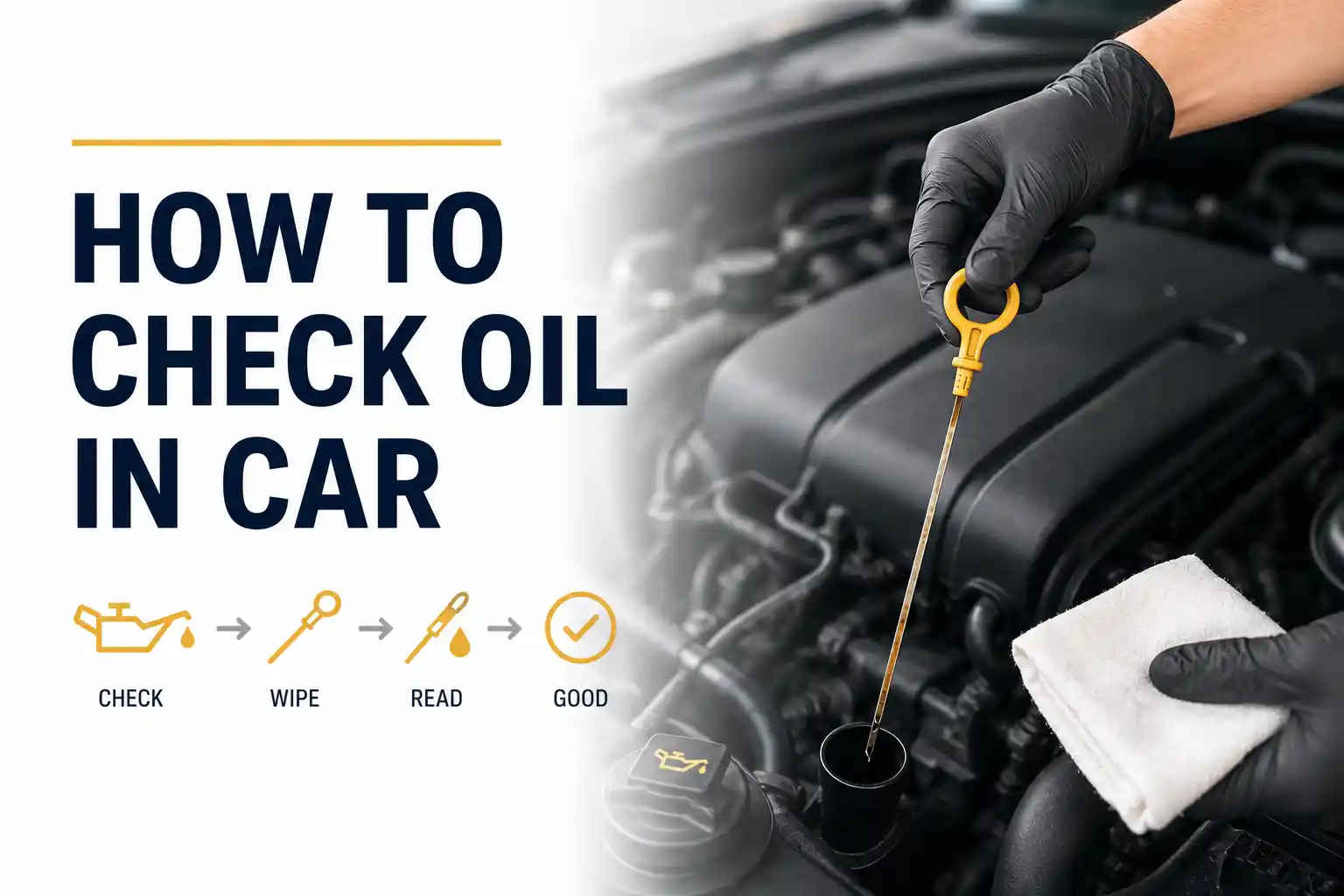
Open bonnet, prop it securely, and locate dipstick. It typically has a yellow handle, orange handle, or red handle sometimes marked with an oil can symbol or the word “ENGINE OIL” on the plastic loop or T-shaped handle. The dipstick tube runs down into the crankcase and oil reservoir below.
Pull out dipstick fully. Wipe dipstick clean from the looped handle all the way to the tip using your clean rag or paper towel. Wipe excess oil completely do not read the first pull. Reinsert dipstick into the dipstick tube, push all the way in until push dipstick clicks into place or seats firmly. Wait a second or two. Pull out again slowly. Now examine both sides and read both sides. Hold dipstick horizontal as you read it tilting introduces pooling errors.
Every dipstick has dipstick markings at the tip. These calibrated dipstick indicators come in several formats: cross-hatched area between two notches (oil should sit within this zone), MIN and MAX labels, L and H markings, or a full mark and add mark. If the oil streak falls within the crosshatch markings or between minimum mark and maximum mark, your oil level check car passes. If it reads below the lower mark or MIN line, you need to add oil before driving.
To top up oil: remove oil filler cap from the top of the engine the oil cap label will confirm it’s the right cap, and the recommended oil type printed on cap saves you checking the manual separately. Use clean funnel, pour oil slowly. Add quarter quart first, wait one minute, recheck dipstick. Add half quart if it’s still low, wait, recheck. Never pour the full quart at once overfilling past the upper mark causes oil aeration from the crankshaft churning through excess oil, and aerated oil cannot maintain the lubricating film that engine protection depends on. Replace oil filler cap, screw cap back on securely, check for spills, wipe any oil off hot surfaces, close hood.
Reading Oil Condition at the Same Time — What You’re Actually Looking For
An oil level check car takes 10 minutes. An oil colour check takes five additional seconds. Do both every time.
Fresh oil is amber oil or golden oil almost translucent against the light, with a clean, slippery feel. As it accumulates heat cycles and combustion byproducts, it progresses through dark brown oil toward black oil. Dark oil alone isn’t the signal to panic oil change interval and oil colour are separate conversations, and gritty oil or grainy oil is more telling than dark oil alone. If the oil consistency on the stick feels thick and rough, chemical makeup changes have degraded it past the point of effective service.
Milky oil or a light milky appearance on the dipstick means coolant is contaminating the oil circuit — a serious situation. Look for blue smoke exhaust or exhaust smoke oil burning from the tailpipe alongside oil smell inside cabin to confirm the picture. Metal particles or metal shavings on the dipstick tip signal internal engine wear that needs mechanic attention before further driving. Burnt oil smell or fuel smell oil from the dipstick suggests oil degradation from blow-by or fuel dilution. Contaminated oil and subpar oil from unknown brands oil risk avoid ultra-cheap oil brands when topping up; obsolete oil sold deceptively can harm modern tight-tolerance engines.
How Often to Check Oil in Car — and What Severe Conditions Change
The car oil check frequency question gets different answers depending on who you ask and what you drive. For a modern, low-mileage vehicle under warranty with full synthetic oil, check oil monthly covers most situations. For higher-mileage cars, older engines, or vehicles driven in severe driving conditions frequent short trips, stop-and-go traffic, towing, extreme temperatures, hot climate oil usage, or cold climate oil check situations check oil weekly makes more practical sense.
UK recommendation from Lookers, RAC advice, and multiple service manual guides settles on a car oil check weekly UK recommendation for anyone covering significant mileage or driving in urban stop-start oil conditions. The broader point: check oil every fill-up costs nothing and keeps you ahead of oil consumption rising trends that develop invisibly between scheduled services.
Oil change interval on modern vehicles has extended considerably. Oil change every 5000 to 7000 miles applies to synthetic oil on most mainstream vehicles. Oil change every 10000 miles is common for European car oil interval; some manufacturers specify oil change every 10000 to 15000 miles on long-life oil interval schedules. Extended drain interval on certain full synthetic formulations can reach 20000 or 25000 miles. For conventional oil in older vehicles, oil change every 3000 to 4000 miles remains appropriate. The oil change 3000 miles old rule that persisted for decades no longer applies universally check your service schedule.
Regardless of interval, oil change every 12 months minimum is a baseline even for low-mileage vehicles, since oil degrades over time through oxidation even without high heat cycling. Oil change every two years is possible on certain modern configurations confirm with your manufacturer recommended interval before stretching beyond 12 months. Failing to follow the warranty oil schedule risks warranty void oil neglect consequences that are expensive and entirely avoidable.
1 thought on “How to Check Oil in Car — The Skill Every Driver Needs Before It Costs Them”