
A mechanic I knew used to say that the cars he saw most often in his workshop weren’t the ones with the biggest problems. They were the ones with the most neglected oil checks. Engines that had been driven on low oil for weeks. Crankshafts running dry. Pistons that had effectively welded themselves to surrounding components because the lubricating film between them had broken down completely. Frozen pistons low oil isn’t a hypothetical it’s a bill that routinely runs into thousands, every bit as preventable as it sounds.
The irony is that learning how to check car oil takes less time than ordering coffee. You need a clean rag, a paper towel or lint-free cloth, and about 10 to 15 minutes. That’s it. What you get back is real-time insight into engine health that no gauge cluster or oil life monitoring system can fully replicate because sensors fail, warning lights miss things, and by the time the oil pressure warning light forces your hand, some damage is often already underway.
The Engine Inside Your Bonnet Is Running a Heat Sink, Not Just a Lubrication Loop
Most drivers think of motor oil as a lubricant and leave it there. It’s more than that. Engine oil functions as a heat sink absorbing heat from internal engine components through heat transfer by conduction and convection and carrying it away from the hottest zones of the engine before it can cause damage. It also suspends combustion byproducts in solution, guards against rust via corrosion prevention, and coats the surfaces of pistons, valves, and the crankshaft with an oil film between parts that keeps metal away from metal under extreme load.
When the engine oil level check car routine gets skipped for months, things start going wrong quietly. Engine sludge begins forming in the crankcase. Sludge buildup chokes oil path engine flow through thin engine pathways modern engines depend on. Oil starts spending more time in the hot frictional zones and less time resting in the oil pan, which accelerates additive degrade quart low. A four quart crankcase typical of most 4-cylinder engines running a quart low is actually running on 25 percent less oil and that 25 percent reduction translates directly into a 33 percent contaminant concentration quart low increase in the remaining fluid. The engine isn’t just running low. It’s running on oil that’s degrading faster than it should because there’s less of it doing more work.
Where to Find Your Oil Dipstick and What You’re Actually Looking At
Before you open the bonnet, check your vehicle handbook or owner’s manual for two things: dipstick location and whether your manufacturer specifies a cold engine oil check or warm engine check. These aren’t interchangeable for all vehicles. Manufacturers used to uniformly recommend cold engine preferred checks, but many have since recalibrated their dipsticks to read correctly when the engine is warm. On the other side of that, some diesel configurations under ACEA specification require specific timing. Your owner’s handbook resolves this in under a minute.
If your car was built in the last several years, also check whether it has a traditional oil dipstick at all. The electronic oil monitor has replaced the manual check in a growing number of vehicles. BMW no dipstick setups, Mercedes-Benz configurations, and Audi digital dipstick display systems all route the car oil check through the infotainment system or digital instrument cluster instead. The graphical digital dipstick displayed in the Audi range is genuinely intuitive but even electronic oil sensor systems carry sensor failure risk, and relying entirely on the onboard computer for oil level monitoring is the same gamble that caused owners damaged engine no warning light situations in early premium brand rollouts. Manual verification still important.
For vehicles with a traditional dipstick: open hood, pop the hood, and locate the dipstick. It’ll have a plastic loop, metal loop, or T-shaped handle sticking out of a flat metal rod often in yellow handle, orange handle, or red handle. Look for the oil can icon or an oil label on it. The dipstick tube runs directly into the oil sump below.
The Correct Car Oil Check Process — Step by Step
Here is where most people make their first error: they read the first pull. Oil splashes on dipstick during engine operation and wicks upward on dipstick along the tube walls as you extract it. That first swipe is inaccurate. It tells you close to nothing useful.
The correct sequence starts with parking the car on level ground level plane, flat surface. Even a slight slope distorts the oil level inside the oil reservoir enough to give you a misleading reading. Engage parking brake. Turn off engine and wait. Depending on your vehicle, that’s wait 10 minutes, wait 15 minutes, or wait 20 minutes give the oil drain back time to settle fully into the oil pan and oil sump. If you’re doing an overnight cold check method, you get the most stable oil level reading possible.
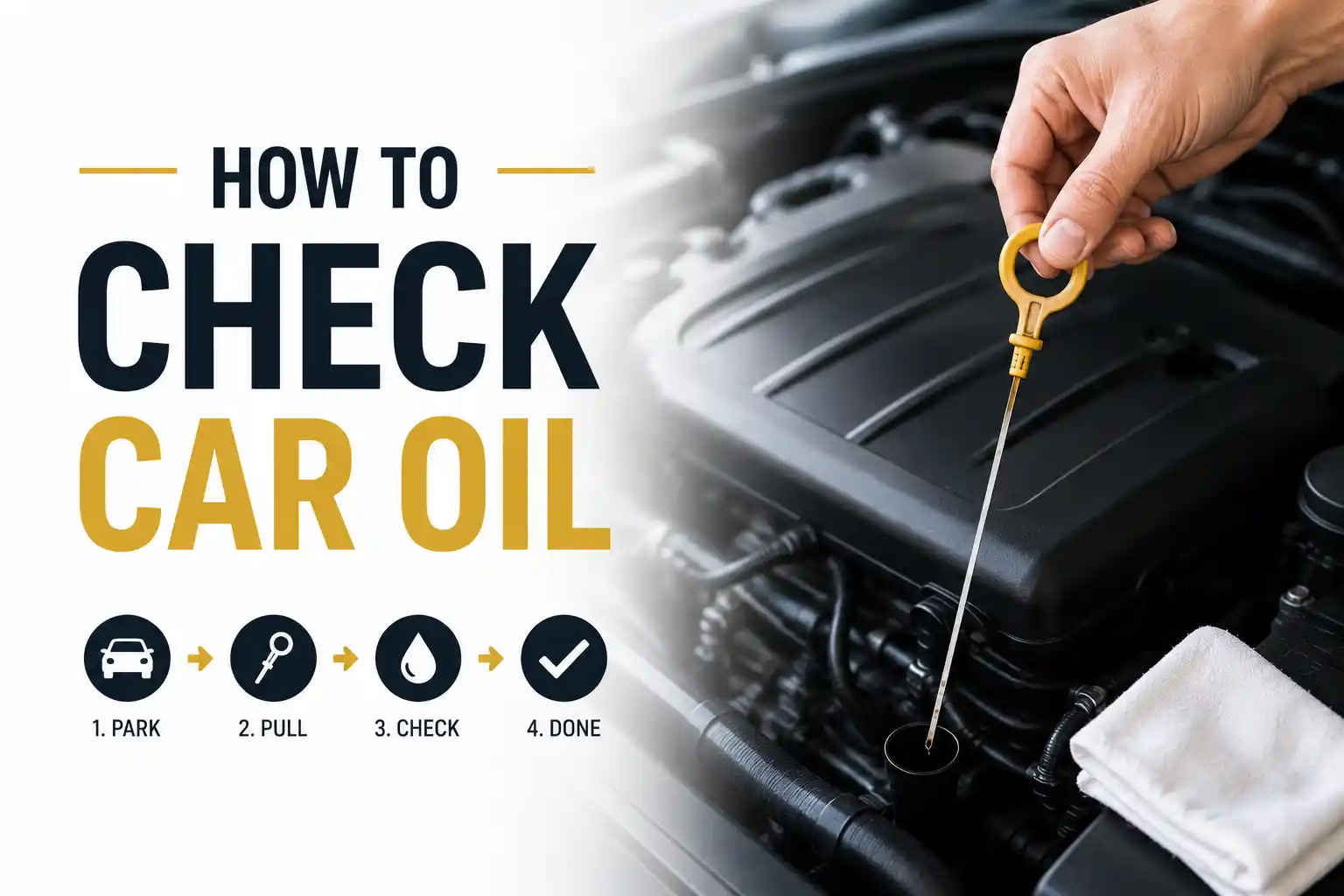
Open bonnet, locate dipstick, pull dipstick out carefully guide dipstick out carefully so you don’t fling oil into the engine bay. Wipe dipstick clean from the looped handle all the way to the dipstick tip using your clean rag, shop towel, or thick paper towel. Reinsert dipstick fully push dipstick all the way back in until it clicks or seats completely. This matters: a dipstick that isn’t ensure fully seated will read lower than actual level and could lead you to overfill. Wait a second or two. Pull dipstick out again. Support dipstick halfway to prevent bounce. Hold dipstick horizontal. Read both sides and note oil level markings.
Every dipstick uses one of several level indicators: crosshatch markings between two notches (safe zone), MIN mark and MAX mark labels, L and H stamps, or F and L (full line and add line). The oil streak should fall within the crosshatched section or between minimum mark and maximum mark. If it sits at or below the lower mark the low mark, low oil warning territory you need to top up before driving further.
To add oil: remove oil filler cap, insert clean funnel into oil fill opening, pour oil slowly. Add half quart first, wait full minute, recheck dipstick. If still low, add quarter quart increments until the reading sits within the safe zone. Never pour a full quart at once. Overfill oil pan creates overfill crankcase problems the crankshaft churning through excess oil creates aerated oil, oil pressure buildup, and eventually overfill seals gaskets leaks as high-riding oil forces past seals not designed to contain it under pressure. Screw oil cap back on securely. Wipe away oil drops from surrounding surfaces. Check for spills, close hood. Save remainder quart for next time.
What Car Oil Colour and Consistency Tell You Before the Dashboard Does
A car oil check done properly includes a colour check. Run the dipstick through your fingers after the second pull not to read the level, but to read the oil itself.
Clean oil slippery feel is what you want. Clear amber oil or light honey colour that’s slightly translucent when held to light. As heat cycles accumulate combustion byproducts and debris in oil, it shifts through light brown oil, dark brown oil, and eventually black oil. Dark colour alone doesn’t automatically demand a change follow your oil change schedule rather than reacting to colour alone. But black oil that also carries a thick viscous feel and gritty feel fingers signals that oil loses lubrication effectiveness and the chemical makeup changes have moved past the point of useful service.
Milky oil or a light milky appearance sometimes described as coffee with cream oil or chocolate milk oil appearance is the visual alarm that stops everything. Coolant in engine oil from a blown head gasket or cracked cylinder head creates this emulsification. Look simultaneously for white sweet-smelling smoke exhaust from the tailpipe and creamy white sludge on oil cap or white oil sludge filler neck. If you see those signs together, do not drive. Tow the vehicle. Coolant leak oil contamination compounds rapidly and can take a repairable engine to a catastrophic engine failure situation faster than most drivers expect.
Metal shavings dipstick or metal particles oil on the stick surface point to internal engine wear piston rings, bearings, cylinder walls deteriorating. Blue smoke exhaust or blue haze exhaust while driving, alongside burning smell oil or oil smell inside cabin, signals oil burning internally through rings and seals low oil damage. These are not situations to manage with a top-up and hope. They need mechanic inspection before the costly repair bill becomes an engine rebuild.
The Correct Oil for Your Car — Viscosity, Type, and Why the Wrong Choice Can Void Your Warranty
Once you know the level is low, the next decision is what to add. Correct oil grade matters as much as quantity. Motor oil viscosity the oil’s resistance to flow, also called oil thickness is rated by SAE using a two-number system where W stands for winter. In a grade like 5W-30, the 5W describes cold temperature viscosity at startup; the 30 describes high temperature viscosity at 100°C operating temperature. Lower first numbers mean the oil flows faster through thin engine pathways on cold start which is why 0W-20, the fastest growing grade in markets like America, dominates modern tight tolerances modern engines that can’t afford sluggish cold-temperature circulation. Higher second numbers like 10W-40 or 20W-50 suit higher viscosity older engines where a thicker oil film is more appropriate.
For oil type, your owner’s manual is the only reliable source. Full synthetic oil offers uniform molecular structure, fewer impurities, superior protection under severe driving conditions and extreme temperatures, and extended drain intervals of 7500 to 10000 miles and beyond. Conventional mineral oil, derived from crude oil refined through distillation, suits older vehicles with lower mileage on simpler combustion systems. Semi-synthetic oil falls between them, typically containing 20 to 30 percent synthetic content in a conventional base, with intervals of around 5000 to 7500 miles. High mileage oil is formulated specifically for vehicles past 75000 miles, carrying additives that condition aging seals, reduce oil burn-off, and slow oil consumption per mileage increase that comes with wear.
European cars running under ACEA specification BMW, Audi, Mercedes-Benz, Jaguar, Volvo often require oils that meet ACEA A3 B4 or ACEA A1 A5 classifications in addition to SAE viscosity grades. BMW Longlife-98 specification, for example, permits extended oil change intervals on qualifying vehicles from 1998 onward. Using an oil that meets viscosity grade but not the required ACEA specification or API rating can void your warranty and harm an engine designed around a specific additive package detergent additive, friction modifier additive, anti-wear additive, and viscosity index improver concentrations all calibrated to a specific oil specification.
Never use ultra-cheap oil from unknown brands. Subpar oil and obsolete oil are actively marketed to look like compliant products. The oil quality difference between a manufacturer-recommended oil and a cut-rate alternative is invisible to the naked eye and catastrophic to tight-tolerance engine components over time.
5 thoughts on “How to Check Car Oil — The Two-Minute Habit That Keeps Engines Alive”