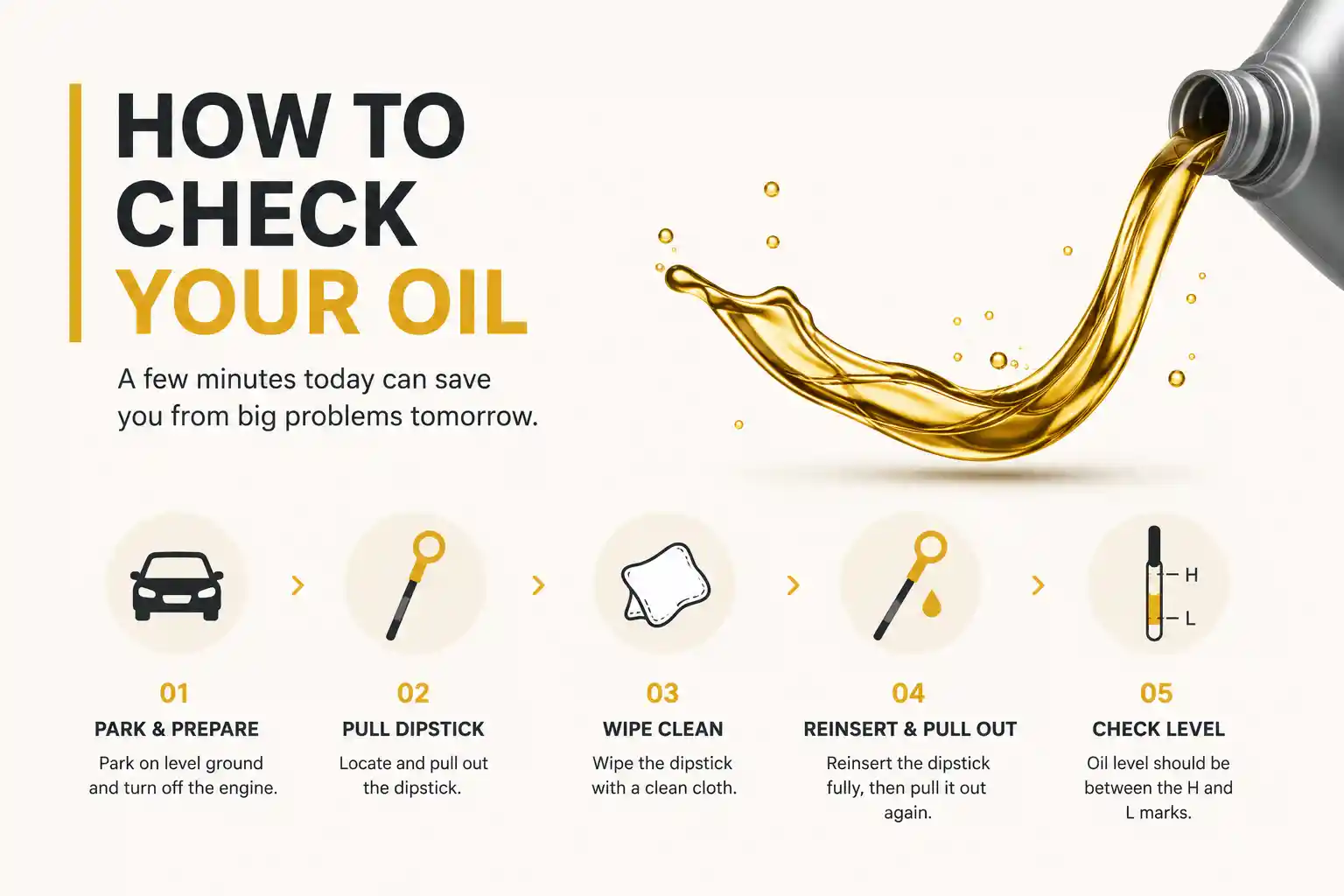

Ask any experienced mechanic what the most preventable engine repair they see regularly is, and most will give you the same answer: engines damaged by low or dirty oil that nobody caught because nobody checked. I’ve seen it too many times. A driver relying entirely on the dashboard warning light waiting for it to tell them something is wrong only to find out the oil warning light means the pressure has already dropped. By then, engine seizes low oil may be minutes away, not miles.
Knowing how to check your oil is a check your oil like a pro skill that takes under 2 minutes, requires no special tools, and genuinely qualifies as investment protection engine for years. Rubin from Firestone puts it simply: without oil, the car won’t run for long. What’s less discussed is that it doesn’t need to be completely empty to cause damage. Even a gradual drop below the safe zone marks starts a slow degradation of engine lubrication that mileage, emissions, and engine lifespan all pay for.
What Engine Oil Is Actually Managing — Why the Level Matters Beyond Lubrication
Engine oil is described constantly as the lifeblood of the engine, and it’s one of those analogies that earns its cliché status. What it actually does inside a running engine is far more layered than friction prevention. It handles debris suspension oil collecting metal particles suspension and combustion by-products suspension and keeping them in suspension until the oil filter traps them. It manages engine cooling in cooling areas coolant inaccessible oil, absorbing heat from zones the radiator and water pump never directly reach. It protects internal moving parts through corrosion prevention and oxidation prevention against acids that form during combustion. And it keeps tight clearances modern engine components from wearing into each other via a sustained oil film between parts.
Every one of those functions degrades as the oil ages inside the engine. Oil ages faster inside engine than it would sitting in an unopened container heat cycling, contamination, and additives deplete heat cycling all accelerate breakdown. Engine controls rely oil pressure and volume to regulate mileage, emissions, and engine efficiency. When oil depletes over time or drops below threshold, the engine harder burns more fuel, reduced fuel efficiency registers across every drive, and pistons, sensors, belts, wiring all of them are at greater risk of overheating damage from heat buildup that oil can no longer adequately manage.
In 2026, many luxury and electric-hybrid vehicles have moved away from physical dipsticks. Ultrasonic sensor and thermal sensor systems now handle real-time oil monitoring in these vehicles, sending digital oil level display data to the instrument cluster or dashboard oil level notification on screen. The 2026 luxury electric-hybrid no physical dipstick shift is real but checking your oil remains the same habit, just accessed through dashboard prompts or the onboard monitoring system instead of the engine bay. For any vehicle without a traditional dipstick, check owner’s manual timing recommendation for the correct digital method.
The Preparation Step That Determines Everything
The most common oil check mistakes happen before the dipstick is ever touched. Park on level ground flat level surface, flat driveway, flat garage floor. Not on a kerb, not across a driveway camber, not on a slope. Oil pools unevenly slope inside the oil pan when the vehicle tilts, creating a false reading in either direction. It needs to be side to side level and front to back level for an accurate result.
Temperature timing is where most guides either oversimplify or contradict each other. Cold engine check recommended remains the most historically consistent advice cold morning best method accurate, overnight parked cold check consistent, because the cold engine oil settled in pan with nothing still circulating. But warm engine check acceptable is now valid for many modern vehicles because manufacturers recalibrated dipsticks warm to read correctly at operating temperature. Not strictly necessary all temperatures to wait for a fully cold engine but always check owner’s manual timing recommendation first, since vehicle specific timing instructions differ.
What you want to avoid is hot engine check false high risk false high reading hot oil expands because oil volume genuinely increases with heat. False reading engine just off also applies because oil still circulating just stopped has not drained back fully from upper engine components. If you’re checking mid-trip at a gas station, 5 to 10 minutes after stop gas station is enough for a reliable reading.
Have your clean rag, paper towel, or clean lint-free towel ready. A flashlight is useful in low light conditions. Wear gloves recommended to keep hands clean. Keep a funnel nearby if the level may need topping up oil spill fire risk exhaust manifold is real: oil spilled on a hot exhaust manifold causes smoke fire oil hot exhaust and can trigger fire hazard oil hot exhaust manifold situations that are entirely avoidable if you use the funnel.
How to Check Your Oil — Every Step Done Correctly
Find the hood release latch usually under dashboard release or at the steering column release. Pop the hood, open hood, locate dipstick. It’s an engine oil dipstick with a plastic loop or looped handle, typically yellow handle, orange handle, or red handle sometimes with a red tab or orange plastic tab. Look for the oil can symbol or ENGINE OIL printed end. The dipstick is usually at front of engine dipstick position, near the valve cover.
Caution: multiple dipsticks engine bay can cause confusion the transmission dipstick nearby looks similar. Engine oil vs transmission dipstick distinction is essential. Consult owner’s manual dipstick if uncertain.
Pull dipstick straight out completely. Here is the step most guides mention but don’t emphasise strongly enough: do not read first pull. The first reading unreliable, first reading coated oil running because splashed oil while driving coats the dipstick tube inside. The first reading sneak peek step only use it to note oil colour cloth wipe for a condition check, nothing more.
Wipe dipstick clean use clean rag, use paper towel, or use clean cloth wipe from handle to tip until you leave clean dipstick bare metal at the end of dipstick. Reinsert dipstick fully. Put dipstick back into tube, push back in all the way until ensure fully seated and push till seated completely. Wait a second or wait a moment. Then pull dipstick out again slowly and read both sides, examine both sides, hold dipstick horizontal.
The oil film stops on stick at the oil film position. Look at the dipstick markings crosshatched area, scored crosshatched area, or crosshatch markings between two lines, or MAX mark and MIN mark labels, or H for high and L for low indicators, or etched lines and two pinholes. Oil between marks good. Oil above upper mark means overfilled oil above max line. Oil near or below lower mark add oil immediately, oil at or below minimum add immediately.
To top up: locate oil filler cap marked with oil can symbol filler cap or viscosity printed oil cap sometimes showing 5W-30 printed on cap as a reference. Remove oil cap, use clean funnel to avoid spills. Add in small increments add quarter quart at a time or add half quart at a time. Wait a minute after adding, re-check level after adding by doing the full reinsert-and-read process again. Add more if still low. Stop between min and max do not overfill. Tighten oil cap securely, replace cap securely. Wipe up spills from any hot surfaces, close hood. Run engine 1 to 2 minutes after adding oil, then recheck after running engine once settled.
What the Oil Is Telling You About Engine Health
The oil colour check technique starts with the first wipe. Fresh oil is amber oil healthy colour clear amber oil, honey coloured oil fresh, golden colour oil, with a fresh oil slippery feel between the fingers. As it accumulates combustion by-products oil and debris in oil, it deepens through light brown oil clean to dark brown oil used and eventually black oil normal used. Brown or black oil normal oil colour naturally darkens. Dark is normal darkens naturally. Oil needs change colour plus condition dark grimy needs change not top up only applies when you combine colour with the gritty oil feel check.
Milky oil coolant contamination or milky appearance coolant leak is an entirely different situation. Light milky appearance concern or cloudy oil investigation means coolant leaking into engine most commonly from a head gasket failure. Simultaneously check for white residue cap coolant on the underside of the oil cap, and blue or gray smoke concern from the tailpipe. That combination confirms serious contamination this is a tow situation, not a top-up.
Metal particles in oil or metal shavings oil visible in the film mean internal wear that needs certified technician inspection before further driving. Burning oil smell inside cabin or oil leaking hot component smell while driving points to oil leak quick loss pull over safely, open bonnet, check for sizzling steam open bonnet before touching anything.
Reading the Label When You Top Up — Choosing the Right Oil
When you do add oil, correct oil grade matters as much as correct volume. Engine oil viscosity is classified by SAE viscosity grade the Society of Automotive Engineers system that assigns the W rating cold temperature and summer grade high heat designations. In 5W-30, the W stands for winter, the 5 is cold temperature viscosity W number, and the 30 is high temperature viscosity second number. Multigrade oil varying temperature grades like 5W-30 and 10W-40 use viscosity index improvers multigrade to maintain protective viscosity across the operating range up to 200 degrees Fahrenheit and beyond.
Full synthetic oil offers the best cold flow synthetic low W performance on cold starts, full synthetic high heat resistance throughout operation, full synthetic fuel efficiency advantages, and longer extended oil change interval schedules. Synthetic blend oil gives synthetic blend cost effective balanced protection for drivers on a budget. Conventional mineral oil suits conventional less expensive conventional replaced frequently maintenance patterns on older lower-stress engines. High mileage oil 75000 miles vehicles benefit from seal conditioners high mileage that reduce leaks high mileage oil and reduce oil consumption high mileage.
Choose oil that meets API SP gasoline engines rating, or ILSAC GF-6 certification, or ILSAC GF-6A turbocharged specification as required by your engine. For European vehicles, ACEA classification European standards including ACEA A3 B4 European diesel or DPF EGR compatible oil ACEA are the relevant benchmarks. BMW Mercedes Volkswagen OEM approval and Dexos GM certification are additional markers that specific vehicles require. The API service classification symbol donut also known as the API donut label on the bottle confirms compliance.
Never use ultra-cheap oil unknown brands harm products subpar oil obsolete deceptive marketing is a genuine market problem where non-compliant oils are packaged deceptively. Always verify same viscosity brand top up when topping up between changes, and when you switch brands, same grade specification is the minimum requirement. Oil can expire unopened container check the batch code manufacturing date motor oil label on the bottle before using oil that’s been sitting in your garage for years.
2 thoughts on “How to Check Your Oil — The Two-Minute Skill That Could Save You Thousands”