
Most drivers check their engine oil fairly regularly. Very few check their brake oil with the same diligence. That imbalance matters enormously, because brake fluid or brake oil as many people call it is the fluid that actually determines whether your car stops when you press the pedal. Engine oil keeps the engine alive. Brake fluid keeps you alive. Those aren’t equivalent stakes, and yet the brake fluid check guide gets far less attention than it deserves.
I’ve seen it play out in real terms: a soft brake pedal, a driver who had never once looked at the brake fluid reservoir, and a stop that came about two car lengths later than it should have. Nothing catastrophic that time just a near-miss that triggered a proper inspection. The brake fluid had absorbed so much moisture its wet boiling point had dropped to a dangerous level. That’s not unusual. In fact, it’s the normal trajectory of every bottle of brake oil in service.
What Brake Oil Is Actually Doing — Why the Level and Condition Both Matter
Brake fluid is a hydraulic fluid. When you press the brake pedal, it’s brake oil that transfers that brake pedal force through the hydraulic brake system to the brake linings that create friction to slow vehicle speed. Without brake fluid, the mechanical action pedal to linings simply doesn’t happen. There’s no direct mechanical link the entire braking force hydraulic transfer depends entirely on this fluid maintaining pressure without compressing.
That last point is critical. Brake oil is a liquid, and liquids don’t compress. That’s what makes the braking force hydraulic transfer so precise. But here’s where the brake fluid maintenance problem begins: glycol-based brake fluid, which covers DOT 3 brake fluid, DOT 4 brake fluid, and DOT 5.1 brake fluid, is hygroscopic fluid. It absorbs moisture from the air continuously. The hygroscopic fluid absorbs moisture through microscopic pathways in the closed brake system hygroscopic setup, and water absorption rate increases over years of service.
As moisture absorption brake fluid increases, the fluid’s boiling point drops. Fresh DOT 4 has a dry boiling point of 446°F. But at just 2 percent moisture DOT 4 lowers boiling 50 percent a drop of 200°F in heat resistance. For DOT 3, 3 percent moisture DOT 3 lowers boiling 25 percent, dropping the dry boiling point DOT 3 401°F by 100 degrees. After 18 months, DOT 3 commonly reaches 3 percent water DOT 3 after 18 months. After years of service, 7 to 8 percent water years service is possible.
When contaminated fluid gets hot from brake fade mountain driving, brake fade towing braking, brake fade heavy traffic, or brake fade repeated hard stops brake fluid boils vapor bubbles form inside the brake lines. These compressible vapor bubbles brake lines are compressible, unlike liquid. Pressing pedal compresses vapor bubbles instead of transferring force to the calipers, producing a sudden loss braking power vapor lock a condition called vapor lock brake lines that renders the hydraulic system inoperable. Brake failure safety hazard road is the outcome. This is not a theoretical scenario.
Brake fluid is also not passive in its environment. The entire braking system lubrication and corrosion prevention brake lubrication function means the fluid’s additive package is continuously fighting internal brake component corrosion. The additive buffers pH regulation control this chemistry but pH additive lifespan limited means once those additives are depleted, pH becomes acidic additives depleted and the fluid starts corroding the system from the inside out.
How to Check Brake Oil — The Visual Inspection Process
The check brake oil process starts with parking on flat level surface flat driveway no slope. Incline affects fluid level in the master cylinder reservoir, making the reading inaccurate. Engine off before checking, and allow engine cool before touching anything hot components burn risk is real, and fluid expansion hot engine distorts the reading.
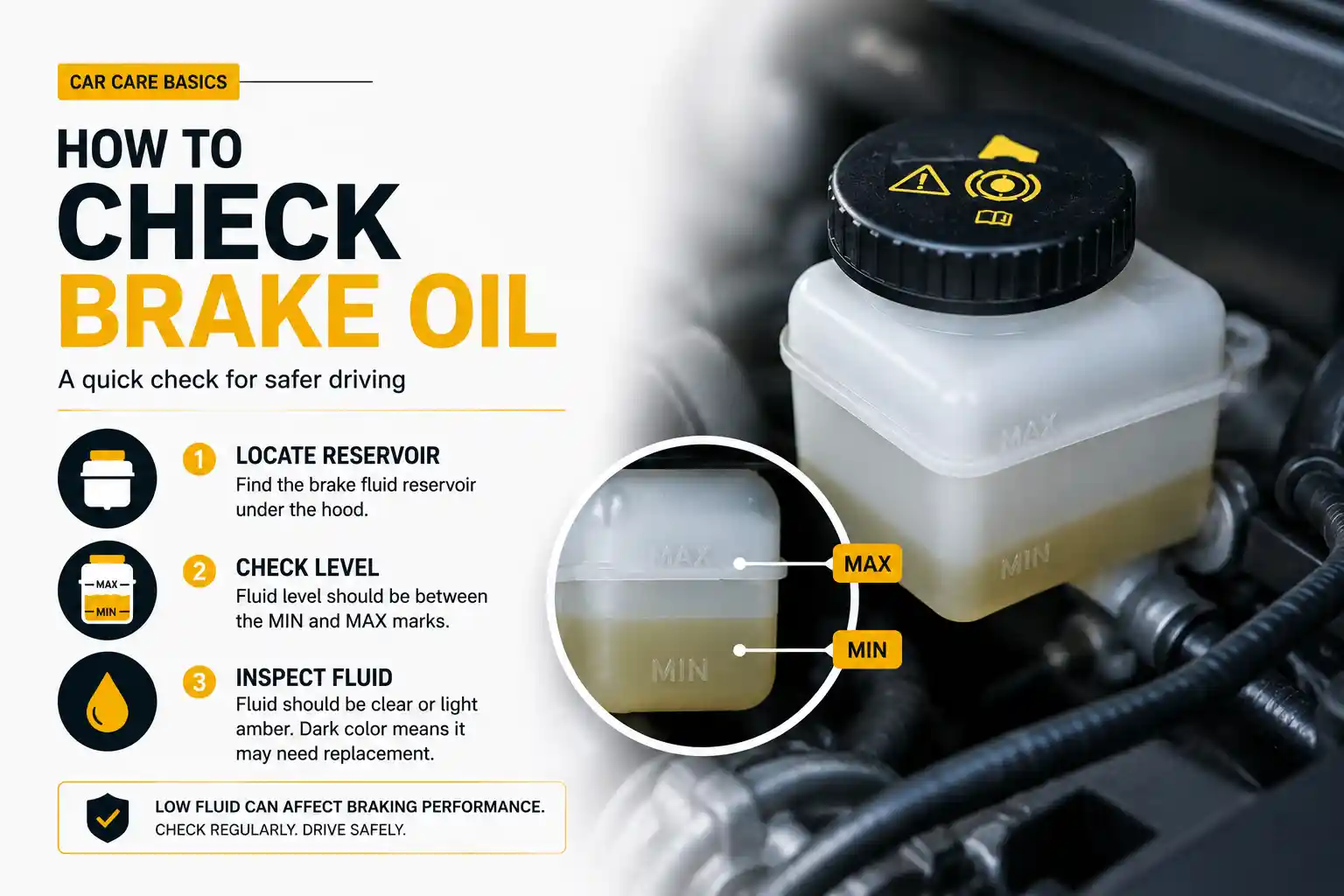
Open bonnet or open hood and locate brake fluid reservoir. The master cylinder reservoir is a translucent plastic reservoir or semi-transparent reservoir typically located behind the steering wheel toward the rear engine bay position attached to the brake master cylinder. Most drivers have never looked at this component. It’s a small, clear plastic container with molded-in markings on the exterior: MIN mark reservoir and MAX mark reservoir, or minimum line reservoir and maximum line reservoir clearly visible without opening the cap.
The check brake fluid without opening cap approach is the first step: look through translucent reservoir, check external markings, visual check reservoir exterior. If fluid at or above MIN acceptable, the level is fine. If fluid near MIN, schedule brake inspection worn pads because low brake fluid often signals brake pad wear. If fluid below MIN act immediately do not drive low brake fluid.
To examine the fluid condition: remove reservoir cap carefully. Clean area around reservoir cap first to avoid contamination when opening. Open cap slowly release pressure. Check fluid colour: fresh clear fluid with yellowish tint is healthy for most glycol-based formulations. Fresh DOT fluid may show a green blue tint fresh DOT fluid or yellow orange tint fresh DOT fluid depending on the additive package. Clear amber fluid acceptable or light golden brown acceptable. Smell burnt fluid change needed if there’s a burnt smell brake fluid that’s a sign of severe thermal stress. Dark fluid flush needed specifically, muddy brown fluid change or black fluid change indicates brake fluid age and debris accumulation. Cloudy fluid replace indicates contamination. Replace cap tightly after checking.
When topping up: top up brake fluid if low by adding the recommended type only, adding to MAX line not above. Do not overfill reservoir. Avoid contaminating with wrong type by checking the brake fluid type sticker cap or DOT rating cap on the reservoir. Clean spills immediately brake fluid dissolves paint, so flush with water brake fluid paint spill immediately and have clean towels water ready before opening the reservoir.
The DOT Rating System — Understanding What Type Your Brakes Need
The DOT rating definition used for brake fluid classification refers to boiling temperatures and base chemistry. DOT classification boiling temperature is the primary differentiator between types. DOT 4 most common fluid type across modern vehicles, particularly DOT 4 European cars. DOT 3 glycol-based suits most domestic cars light trucks US. DOT 5 silicone-based is non-hygroscopic silicone base non-hygroscopic DOT 5 making it hygroscopic fluid absorbs moisture resistant, but DOT 5 not compatible ABS, which eliminates it from virtually every modern vehicle with an antilock braking system. DOT 5 classic cars motorcycles remains its appropriate application. DOT 5.1 glycol-based has a higher boiling point than DOT 4 and is DOT 5.1 compatible ABS ESC, making it suitable for DOT 5.1 high performance vehicles.
Mixing brake fluid damage is serious. Do not mix brake fluid types under any circumstances especially mixing DOT 5 with DOT 3 DOT 4 damage, since DOT 5 incompatible other types causes chemical reactions that alter fluid consistency. Mixing incompatible brake fluids causes seal damage wrong fluid type, internal seal deterioration wrong fluid, and hydraulic component damage wrong fluid that may not show up immediately but will compromise the system over time. Wrong brake fluid damages seals silently before the wrong fluid brake responsiveness damage becomes obvious. Always use same type as existing system confirm via correct formula printed reservoir cap or correct formula owner’s manual.
BMW Normal formulation and BMW Low Viscosity formulation represent OEM-specific brake fluid requirements for the BMW range, covering BMW DOT 4 DOT 5 DOT 5.1 variants depending on model year. Always check owner’s manual brake fluid spec or contact an OEM-certified service center for vehicle-specific guidance.
Testing Beyond Visual — Copper Strips, Conductivity, and pH
Visual inspection brake fluid tells you colour and level. It cannot tell you moisture content or additive depletion. Colour unreliable moisture content colour unreliable moisture detection visual alone insufficient is documented: dark fluid not always contaminated moisture, and clean-looking fluid can be chemically exhausted.
Chemical test strips brake fluid offer the most practical at-home testing method. BrakeStrip copper test strips work by measuring the copper level parts per million ppm in the brake fluid. Copper contamination brake fluid comes from copper from brake line lining the copper-lined inside brake lines are brazed copper alloy inside brake lines, and as corrosion occurs, copper is pulled off corrosion and copper suspended brake fluid accumulates. The more copper, the more the corrosion inhibitor degrading monitoring reveals a system under chemical stress. Copper damages ABS components specifically copper platelets ABS valves malfunction and copper accelerates iron corrosion in steel brake lines and calipers.
The BrakeStrip industry standard 75 million tests has established 200 ppm copper service needed as the threshold requiring immediate fluid change. The 30 ppm Tesla monitor 4 years threshold reflects a monitoring category where the fluid is degrading but not yet critical. Dip BrakeStrip one second test, start 90 second timer after dipping, then compare colour chart container. Deeper purple greater copper contamination.
For more precise testing: refractometer brake fluid test measures refractometer specific gravity measurement using drops of fluid on prism refractometer, then look through eyepiece scale to read moisture calibration. Conductivity tester brake fluid uses electrical resistance tester brake fluid the pencil-style brake fluid tester passes electricity through the fluid, with conductivity higher more moisture indicating greater water content. The pH test brake fluid using pH strip brake fluid test measures additive depletion when pH becomes acidic additives depleted the system needs flushing regardless of colour.
The voltmeter galvanic reaction test provides a professional alternative: place voltmeter negative battery post to the negative terminal, insert positive lead inserted brake fluid into the reservoir without touching metal. Over 300 millivolts recommend fluid change because galvanic reaction brake system battery is generating measurable voltage from corrosion chemistry in progress.
How Often to Check Brake Oil and When to Replace It
Check brake fluid every few months as a minimum. Check brake fluid every oil change is the easiest habit to build it pairs naturally with the bonnet-open routine you already have. Check before long journey without exception, and check before MOT UK to avoid MOT fail brake fluid contamination UK issues. Since 2018 MOT contamination inspection requires brake fluid to pass both level and contamination checks the MOT brake fluid contamination check since 2018 has made this a formal safety requirement rather than an advisory.
Change brake fluid every 2 years for DOT 4 the DOT 4 2 year saturation timeline specific represents the point at which 3.7 percent water volume saturated is typically reached. Change brake fluid every 1 year DOT 3 matches the faster 2 percent water DOT 3 after 1 year contamination timeline. The manufacturer 24-month lifespan brake fluid is a general guide, but vehicle age fluid change gap, ownership change fluid change gap, and pandemic interruption fluid service gap all represent situations where the interval may have been missed and the check needs to happen immediately regardless of age.
If the fluid is dark, burnt-smelling, or has tested above the copper contamination threshold proceed to brake fluid flush, not a simple top-up. Flush replace contaminated fluid completely, because the top-up new oil old oil issue applies here too: adding new to old worn oil issue means contaminated fluid diluted by fresh fluid still contains the degraded additive package and accumulated copper that caused the problem. Brake fluid exchange through a gravity bleed method or a workshop bleed and flush removes the entire fluid volume from the hydraulic brake system and replaces it fresh.